

I am finally, belatedly, accepting movement as just as foundational as my morning meditation.
I’ve never been much of an athlete. I have no interest in sports and as a teenager I could barely catch the ball before it hit my face. Then I spent two decades at desks. I went through phases of lifting weights and occasionally tried yoga. I did it the way a monkey would: imitating without understanding. Of course, I was not flexible enough for many poses and with little to show for my straining I always stopped again.
Free form dance has shown me my body’s limitations. One reason I fall into the same patterns is that a lot of moves feel inaccessible. Seems like my lower back does not want to bend much? I guess these hips don’t like to rotate? Wait, am I getting ‘tech neck’? It’s frustrating to notice these signs of bodily neglect, and yet I did very little. A bit of stretching here and there. Of course, the longer this goes on, the harder it feels to change course. A few weeks ago, I had my wake-up call.
I was visiting my 89-year-old grandfather, my last living grandparent. The summer’s first heatwave had ended and I pushed his wheelchair through the drizzling rain under a heavy grey sky. Opa has dementia and I’m used to not being recognized or having a conversation. What shocked me was his wheelchair-bound body.
I had been away for a year and a half. During that time muscles vanished, the torso curved, the legs retreated into the unnatural bend in which they spend most of the day. Opa used to run a farm and ride his bicycle around the village. Now he can barely get up and get into bed. It dawned on me that this was simply an extreme case of what prolonged sitting can do to any body — what it subtly has been doing to me, too.
A week earlier I had attended a weeklong workshop with Simon Borg-Olivier in Berlin (all quotes based on my notes). I had seen him do his trademark abdominal roll, a degree of muscle relaxation and control that blew my mind. I knew I had to learn from him.
The goal, Simon explained, is to live in “a functional, pain-free body” and feel good across “five temporal dimensions”: while doing the movement, immediately afterwards, the following days, weeks, and years, as well as into old age. Simon learned this the hard way.
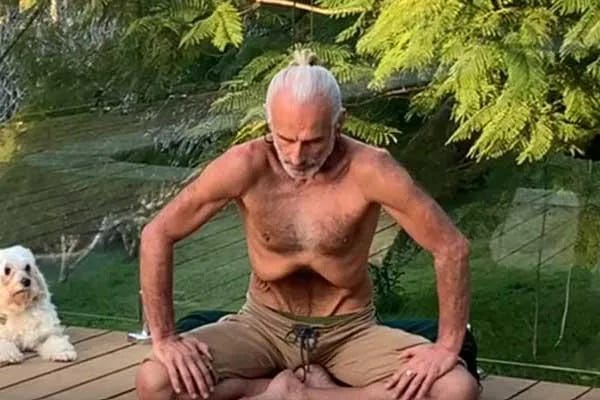
His background is unusual: at six years old his free-diving father taught him long breath-holds. Then he learned how to massage his organs by moving his abdomen. As a teenager he met a Tibetan Lama who could control his body temperature and would sit in the snow nearly naked. Simon studied yoga, human and molecular biology, massage, physiotherapy, and martial arts. Now he is a walking yoga and anatomy textbook whose wisdom I can’t do justice. Still, I feel called to share a few highlights that deeply affected me (or hear from him directly: My philosophy of how to practice posture, movement breathing & mental control).
“The Indian yogis didn’t understand,” he reflected on the pioneers who introduced Hatha Yoga to the West. “The Indian system was not appropriate” for the Western body and mind. We sit all day and rarely squat. We are conditioned to be competitive, ambitious, and tough on ourselves. We turned yoga postures into another workout routine and Instagram-worthy performances. Simon mastered and taught the challenging Ashtanga Yoga.
“The ones who go hard,” he reflected, “10-15 years later, they get problems.” Injuries, joint issues. “I’ve broken every bone,” he quipped, “messed up my body.” He needed something more sustainable.
“Learn to make it effortless,” he instructed us. “What I’m teaching is effectively movement meditation.” The practice must be sustainable, engaging and invigorating, yet also calming and effortless. Move gently and push yourself only 1-10% of the time. Let the nervous system remain in parasympathetic state: practice without heart racing, panting, or much sweat. On the last day of the workshop, we practiced for three hours in the morning and two more in the afternoon (and without air conditioning because Germany. . .). I expected to stand in my own sweat, ‘hot yoga’ style. Far from it.
For Simon, “yoga ends where stress starts.” This was a surprising experience for me as I’m used to feeling wiped out after weights, cardio, dance, and even yoga. Simon calls his sequences a “work in”: if after a workout you feel hungry, tired, and sore, his practice should leave you energized and with less need for food and rest.1 He is looking for the benefits of exercise and sleep. “Make the aim of your practice connecting with yourself. Let strength and flexibility be a byproduct.”
I see his story as an example of how our setbacks are necessary to catalyze our growth. Obstacles are a prompt for us to rise to our unique potential.
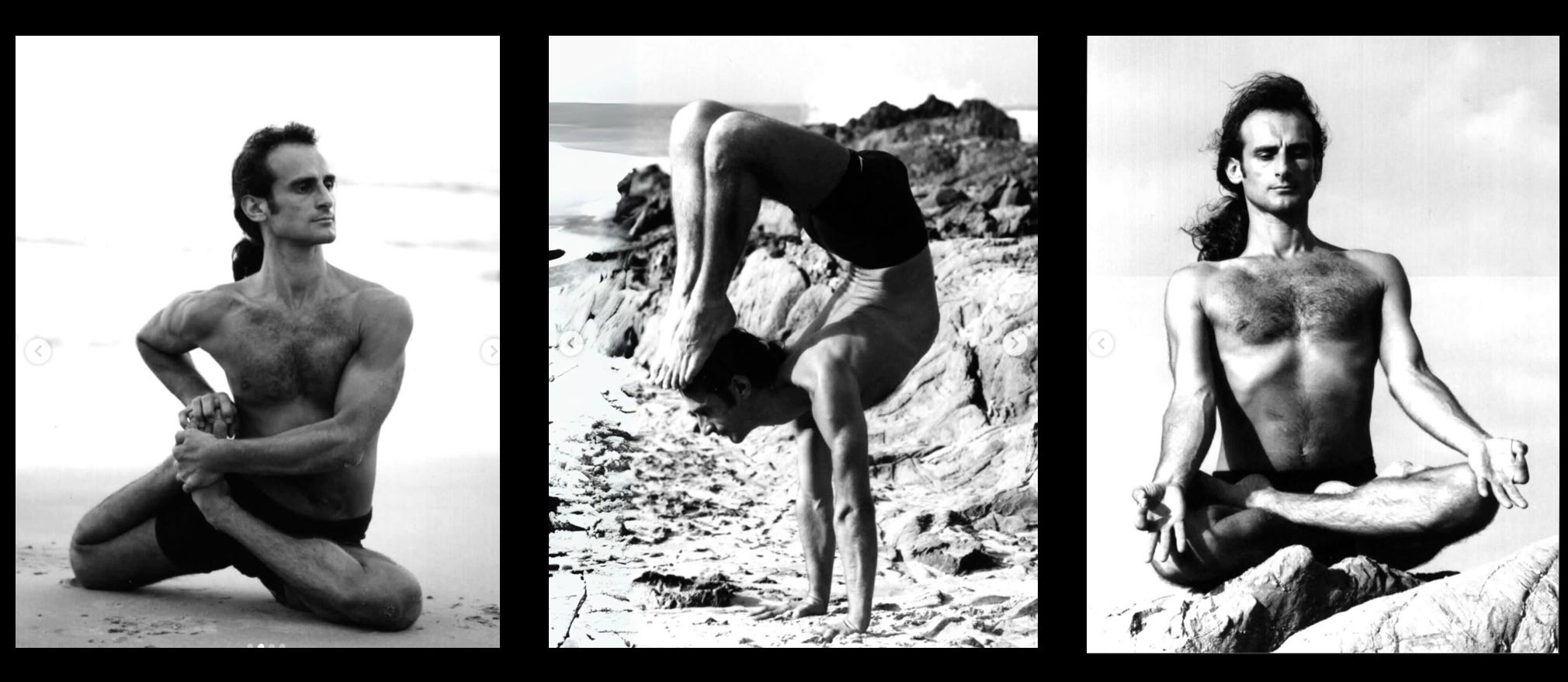
The foundation of this flowy meeting of Yoga and QiGong is what he calls the “movement at the base of all movement”: a sequence of spinal movements originating from the core (lower Dantian). One moves the spine or trunk in five dimensions: lengthening and shortening, forward and backward, bending to each side, twisting, and expanding and contracting. His YouTube channel has many demonstrations, like this one or this short one (his website also has a detailed introduction — edit: my favorite introduction is this Basic 5D Synergy Flow Fundamentals Yoga Class with the 5D flow starting at minute ~19).
A favorite of mine is the spinal sequence with its one-legged postures that challenge me and my flat feet (full sequence with verbal and visual instructions). Other sequences focus on the joints (full practice) and yoga-style postures (again more on his website).
I am still learning these basic movements. Often I find that body parts snap back into old patterns as soon as my awareness moves on. A predictable result, I suppose, of a lifetime spent sitting.
Another one of his techniques is to “relax what you don’t need,” a kind of body scan he calls the “bridges to the unconscious” (pelvic floor, abdomen, fingers, shoulders, neck, and face). He uses this during movement, meditation, and pranayama and I like to start my seated meditation with it. (How to Reset to Nervous System and Easy Relaxation Hack — “If you took away just one thing, let it be this one.”). Learning to relax the body in a controlled environment is very valuable when life gets stressful: “when you can’t control what’s happening outside, you have to shift on the inside.” “If a situation is stressful,” he joked, “I think, ‘ok I’ll relax my anus in that case.’”
I don’t think it matters much whether one practices Simon’s flows or a similar practice. But I am convinced that something like this is absolutely necessary when our lifestyle and environment — sitting, screens, chronic stress, etc. — actively conspire against our health. “I don’t want to be a supernatural being,” Simon quipped about the yogic pursuit of special powers, Siddhis. “I’m quite happy to be natural in an unnatural world.”
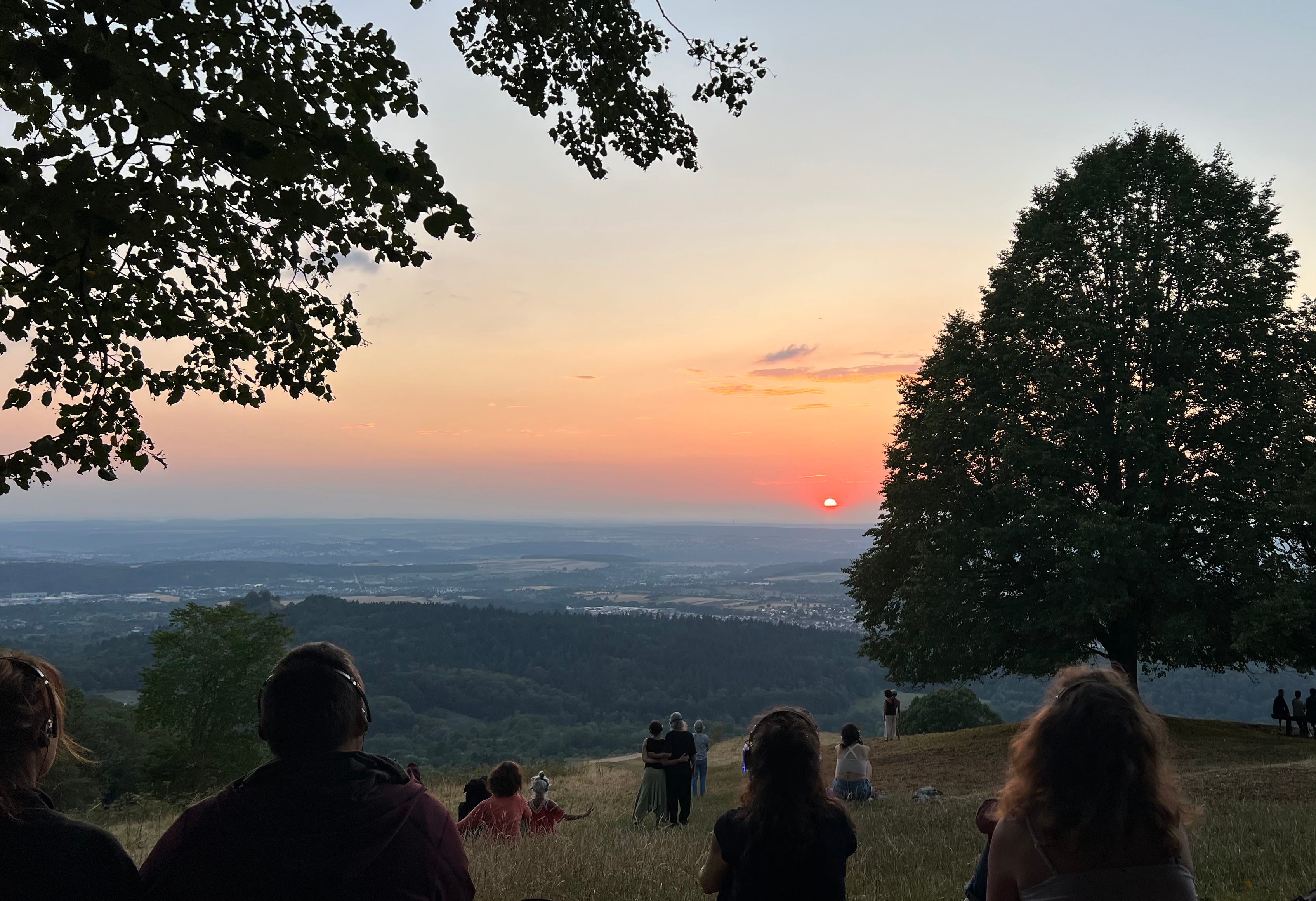
Long gone are the days when I could go for a walk with grandpa. But yesterday I joined my mother for a silent dance event on a mountain near my hometown. The grass was soft and wet under the bare feet, the evening air pristine. The crowd moved silently with their headphones. I felt a little more at home in my body, yet also noticed every creak and pop in my spine. Not quite there yet. . .
By the end of the perfectly timed set, the sun disappeared into a shimmering red pocket of clouds. On the drive home I pitched Mum on the value of Simon’s movements. Old age is inevitable, how we meet it is a choice.
“Enjoy your life, have a healthy body, use it to help others,” Simon summed up his take on life. That’s what I want, as long as possible.
May you be healthy and blessed.
Frederik
While on tour he does 6-days of workshop plus a travel day back-to-back. Thanks to his practice (movement and pranayama) Simon claims to get by on 4.5 hours of sleep and one meal, dinner, of mostly fruit and salad (plus a cacao-Macca-pepper-coconut oil-dates energy drink). After a short night he believes two hours of his practice are better for his body than trying to catch up on sleep.
Thanks for sharing, Frederik. I’m excited to try these movements.
Very informative, thank you Frederik. (I will sign up for his "5Dimensional Flow Moving Meditation" 1-hour Masterclass.)