

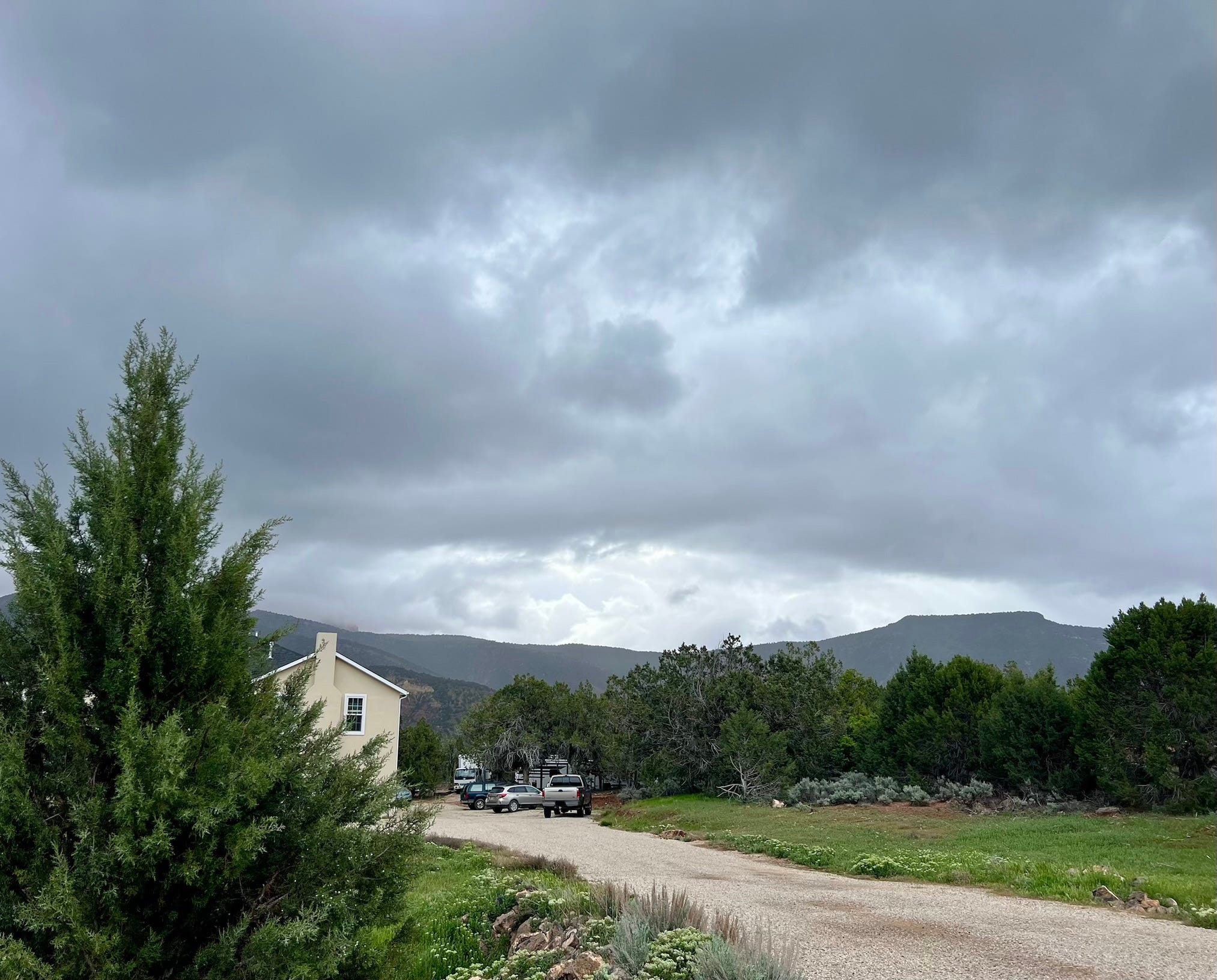
A storm is passing through Southern Utah. I walk in the drizzle, watch the juniper trees sway. Back inside I listen as the storm tears at the windows. Smoke curls above a stick of incense. As I fall on the sofa, for the blink of an eye, it occurs to me that I live inside the heart of God.
I don’t mean Me, Here, Now but All of us, Everywhere, All the time. And yet, most of the time it does not feel that way, does it?
“All of our life, everything we do, think, and feel is surrounded by nothingness,” John O’Donohue writes in Anam Cara. This “cosmic loneliness is the root of all inner loneliness.” Can one come to terms with that emptiness, and with the violence, inside the cosmic heart? Can one resist the urge to escape, to retreat into spaces gated and clean, protected, pristine, whether digital or spiritual?
Can one feel at home in messy, holy, bloody mud?
Can one fall in love with creation regardless?
I pack my bags. Time to drive to Salt Lake City. Time to sell the car, to release all that won’t fit into two suitcases. Time to close a chapter.
If contemplation is taking on the heart of God in the heart of the world, then the contemplative, perhaps more than any other, weeps over the obliteration of the will of God in the heart of the universe. — Illuminated Life, Joan Chittister. (Thank you to James Bailey for the book!)
“We cannot fill our emptiness with objects, possessions, or people,” O’Donohue writes. We cannot. Oh, but we try. “We have to go deeper into that emptiness; then we will find beneath nothingness the flame of love waiting to warm us.”
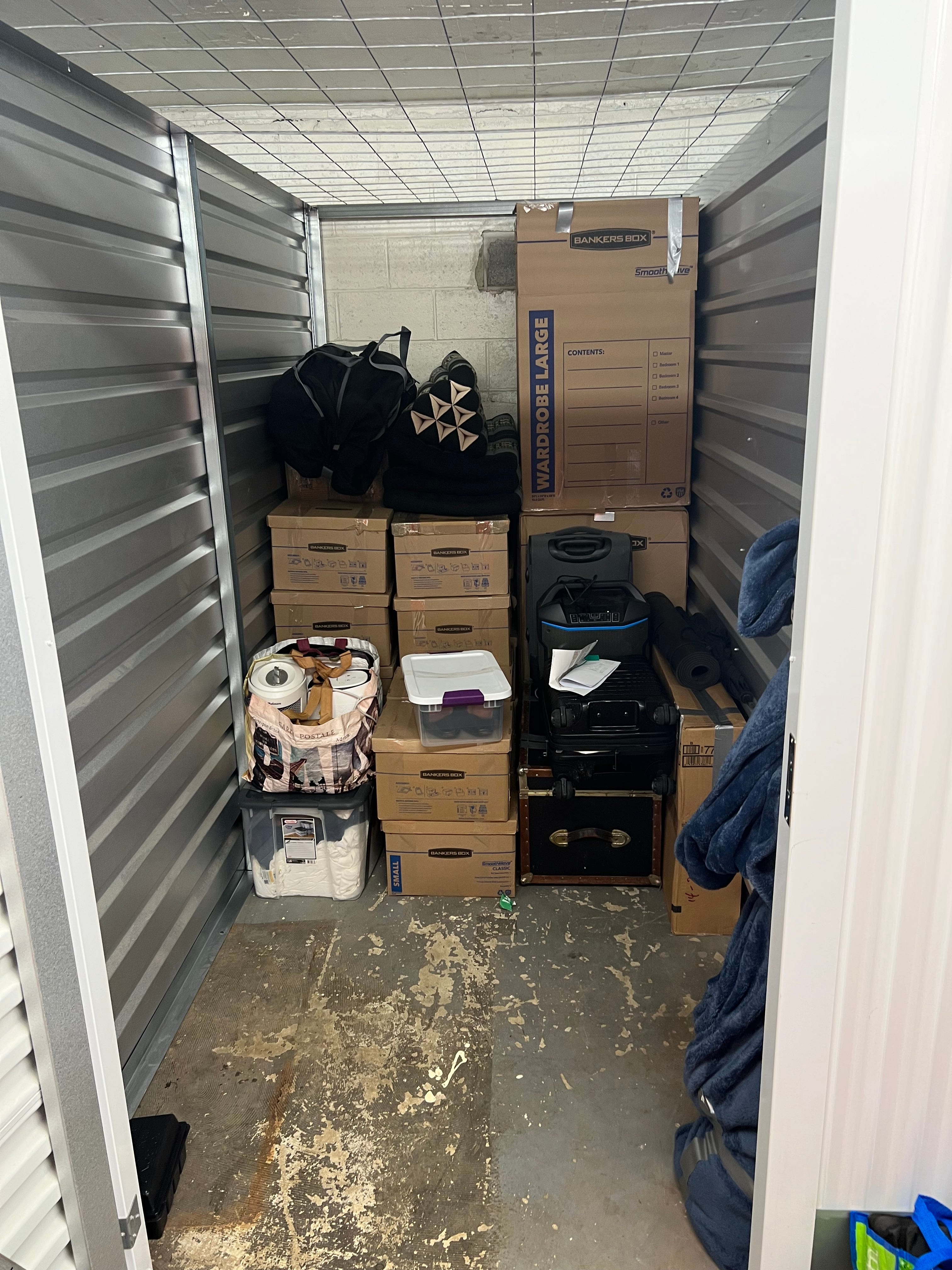
I arrive in Newark, New Jersey, to face what I used to camouflage the fear of nothingness. All of it went into storage when I left New York City nearly a year ago. For this I pay a hundred dollars a month, a reminder of a postponed painful encounter.
I brought a friend for support. When we open the door a jarring alarm rings through the hallway. The air in the storage unit is musty, thick with heavy memories. The devils of my American life wait among the boxes of this warehouse tomb.
We begin to fill large garbage bags. I want it all gone. Donate it, throw it out, I don’t care. I move quickly. I don’t want to feel what the room is holding. I retreat into silliness, into repetitive jokes, into comforting verbal loops. My friend informs me that I am “stimming,” self-regulating through sounds. When we break for lunch the universe throws a flag.
Lights flash in the rearview mirror. A cop pulls us over somewhere in New Jersey’s manicured soccer-mom-suburbia.
“You ran a red light.”
Did we? Maybe?! I have no idea. I am floating in a cloud of my own chatter. His voice hits me like a splash of cold water. I have never been pulled over, ever. And I don’t believe in coincidences, especially not on this trip. When the cop steps away, I pray. I ask for support, for harmony, for guidance. Can we bathe this whole situation in light, please?
The officer returns in a better mood. There are fines and summons, but the tension has vanished. As we munch on bento boxes, my friend and I try to make sense of what happened. We ran a red light. We were unaware. We rushed. We failed to stop.
Instead of pausing to honor the excavation and burial of my old life, I had closed my eyes and hit the accelerator. I refused to make the unconscious conscious. So, the universe forced me to hit the brakes.
We clear the air with smoke and sound, with prayer and invocation. My friend is an expert in these matters, I am a committed novice at best. After an exhausting two days, it is time to cross this threshold.
To be holy is to be home, to be able to rest in the house of belonging that we call the soul. — John O’Donohue, Anam Cara
Home remains a fleeting experience for me, as if my destiny was not to belong but to be in longing.
When I grew up, home seemed simple and tangible: family, the house, friends, culture, Deutschland. Familiarity and bonds of blood felt constricting, suffocating, too small. I could not wait to leave.
New York became home through relationships: marriage, work and, later, healing and spiritual community. But my roots never broke the concrete. I was a renter, a guest, straining against walls, always reaching for sunlight and more space. I never fully arrived.
Before I head to the airport, I meet a friend for breakfast in Midtown. Manhattan is chilly this morning. People rush past me with clenched faces. The place feels overcaffeinated, dysregulated, an assault on the nervous system. My friend’s mind seems to be running at ten times the speed of my own. I consider the consequences of opting out of this cultural hotbed. I like who I have become, but my writing has slowed down drastically. Maybe I think like a tree now, forming thoughts like leaves, one season at a time?
I’ve experienced home downward, in roots and soil, in history and ancestry. I’ve also felt it in the lateral branches of relationships. But home also occasionally reveals itself inward and upward, in the refuge of a full heart, in moments of transcendence. Is home wherever we glimpse our wholeness?
Purifying my physical circumstances repeatedly has created an invitation to revisit the inner room. What attitudes and beliefs make up its walls and tapestry? Can I feel its outline, its texture? Is it inviting? Have I bolted the door and shuttered the windows? How did I ever let it become so cluttered?
The day of departure is filled with Doppelgänger encounters, with faces reminiscent of old acquaintances. Everything seems familiar yet distant. I can’t stay. Every ending implies a beginning and, as I board the plane, I wonder where my wandering heart will lead me.
I maintain that Truth is a pathless land, and you cannot approach it by any path whatsoever, by any religion, by any sect. . . . Truth cannot be brought down, rather the individual must make the effort to ascend to it. — J. Krishnamurti
How to find that inner home? I used to think stillness was the “correct” path. Meditation appealed to me. Prayer arose more spontaneously. After some recreational experimentation, I was taught psychedelic ceremony as an inward journey supported by sacred instruments and music.
And yet, some of my most freeing experiences have been in movement. I know the energy of dance can lift the ceiling and open a portal. I had to learn how to dissolve and let myself be moved. Once I did, there was no turning back.
“What we are ready to learn is that heightened arousal, whether through wild dancing, spontaneous jumping up and down, or body shaking, is as valuable a healing and transformational practice as sitting quietly in a lotus position,” Bradford Keeney writes in Shaking Medicine. This guy gets it, I thought.
Brad spent a lifetime following visionary dreams and immersing himself in ecstatic, shamanic, and healing traditions including the Kalahari Bushmen (San) of southern Africa and the healers of Bali, Mexico, Brazil, St. Vincent, and Japan. He and his wife Hillary now facilitate, teach, and write under the name Sacred Ecstatics. When I saw that they offered a weekend workshop in Budapest, I changed all my flights.
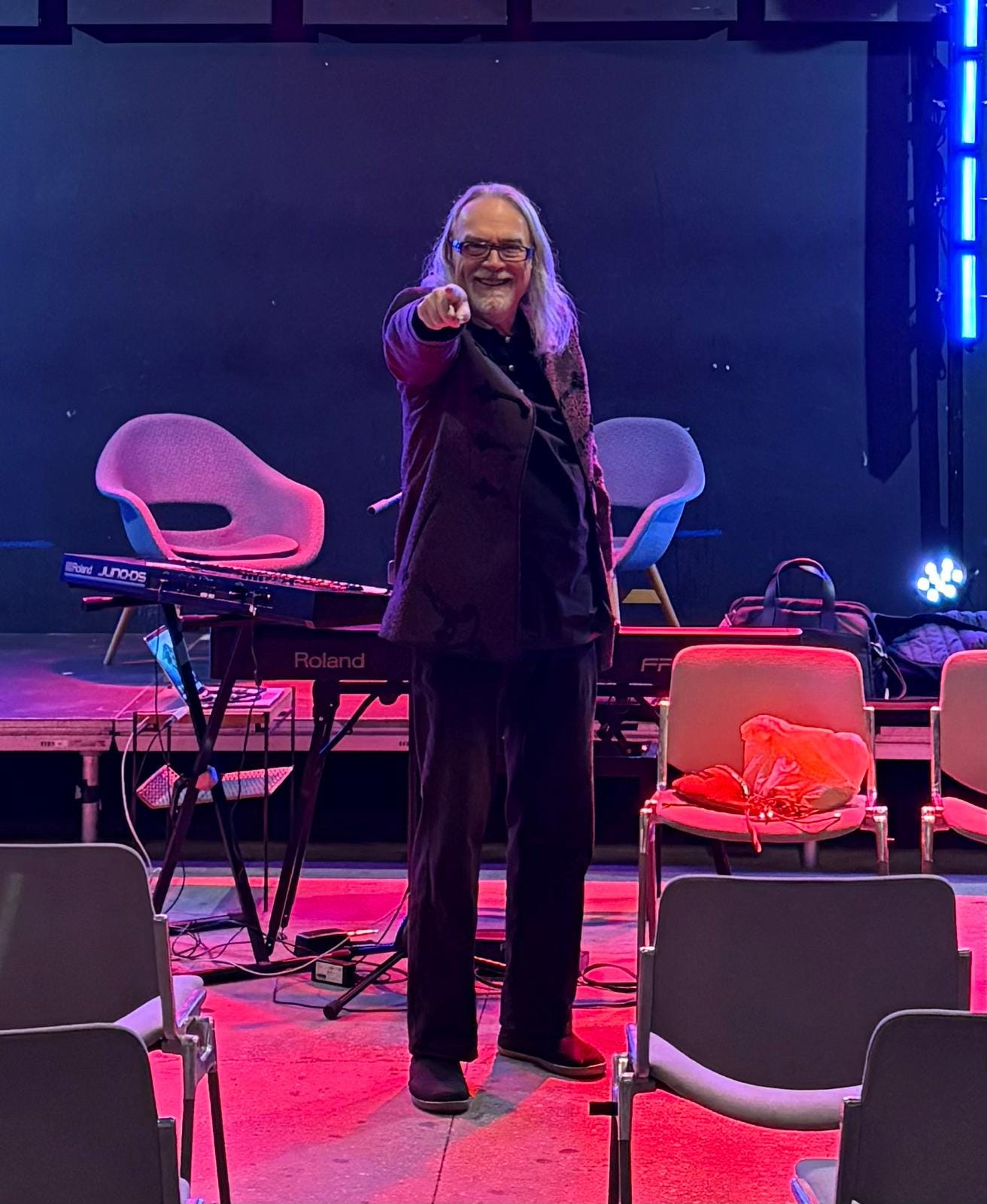
Brad is an Unikat, a genius musical shaman, truly one of a kind. He is posted in front of two Roland synthesizers and plays sequences of rapidly changing rhythms (“all of my music lessons came from the other side,” he explains; a few examples are on Soundcloud). The audience rocks and sways, back and forth, waiting to catch a “stray,” a jolt of energy, a spontaneous shaking movement.
Brad calls it the “spiritual engineering of sacred ecstasy.” His formula is ESM: (sacred) emotion, sound, and (spontaneous) movement. These feed on each other and raise the “spiritual temperature.” The goal is to prepare a “big room” for the divine and “get cooked.” The intention is to climb upward on one’s “rope to God.” It’s very different from anything I’ve done before.
While one of my new friends has an instant kundalini awakening, I spend my days rocking and swaying, listening intently, and occasionally falling into shakes and spasms that remind me of TRE. On the last afternoon, I find a deep space of sadness and yearning. Why won’t You let me draw closer? Why do I have to return to this tiresome world? Tears stream across my cheek.
It feels like I’ve stumbled across something profound, yet I barely managed to touch the rope, let alone climb. The jewel of jewels remains remote. It hangs over my life like the full moon over Budapest.
“The secret of life is to move from observing to serving.” — Hillary Keeney
How odd to think about ancient medicine when everyone is talking about AI. But I don’t know what the world needs or where it is going. I barely know what I yearn for: wholeness and presence, surrender and devotion. Stillness and ecstasy. To feel deeply alive, to return home, if only for a moment. And to become a True Participant, as Hillary put it, a co-creator with the divine.
Brad seems to believe there is a near-universal answer to life’s problems. Diagnosis? Analysis? Convoluted questions about the ineffable? “Trickster territory” of the mind. Too many words. Spiritually cold. He answers with a shriek or a channeled song. If you find yourself in a funk, it’s the “ancestors reminding you there’s not enough dancing!” “Wake up,” he shouts from behind the keyboard.
Is what I’m looking for as simple as gathering around a fire with a drum and a deep longing to reconnect with the infinite? I don’t know. And that’s okay. I let go of the books and the need to know. My intellect used to have unquestioned dominion over my life. Instead, I want to make room for play.
Language and knowledge seemed like the master key to life. But always my intellect felt the need to define and to draw distinctions: it’s this not that. Brad would call this “ground talk.” My heart on the other hand knows the unity behind all contradictions. The heart can embrace paradox because it does not need to be explicit. The heart does not explain. It simply breaks or is lifted in a lifelong dance.
Frederik, so deep. So beautiful. So vulnerable and heartfelt. When I read your words I feel as if I’m communing with the divine. 🙏
And this: “My heart on the other hand knows the unity behind all contradictions. The heart can embrace paradox because it does not need to be explicit. The heart does not explain. It simply breaks or is lifted in a lifelong dance.”
Any comment I make about that passage would be too small.
Love you, Frederik❤️