

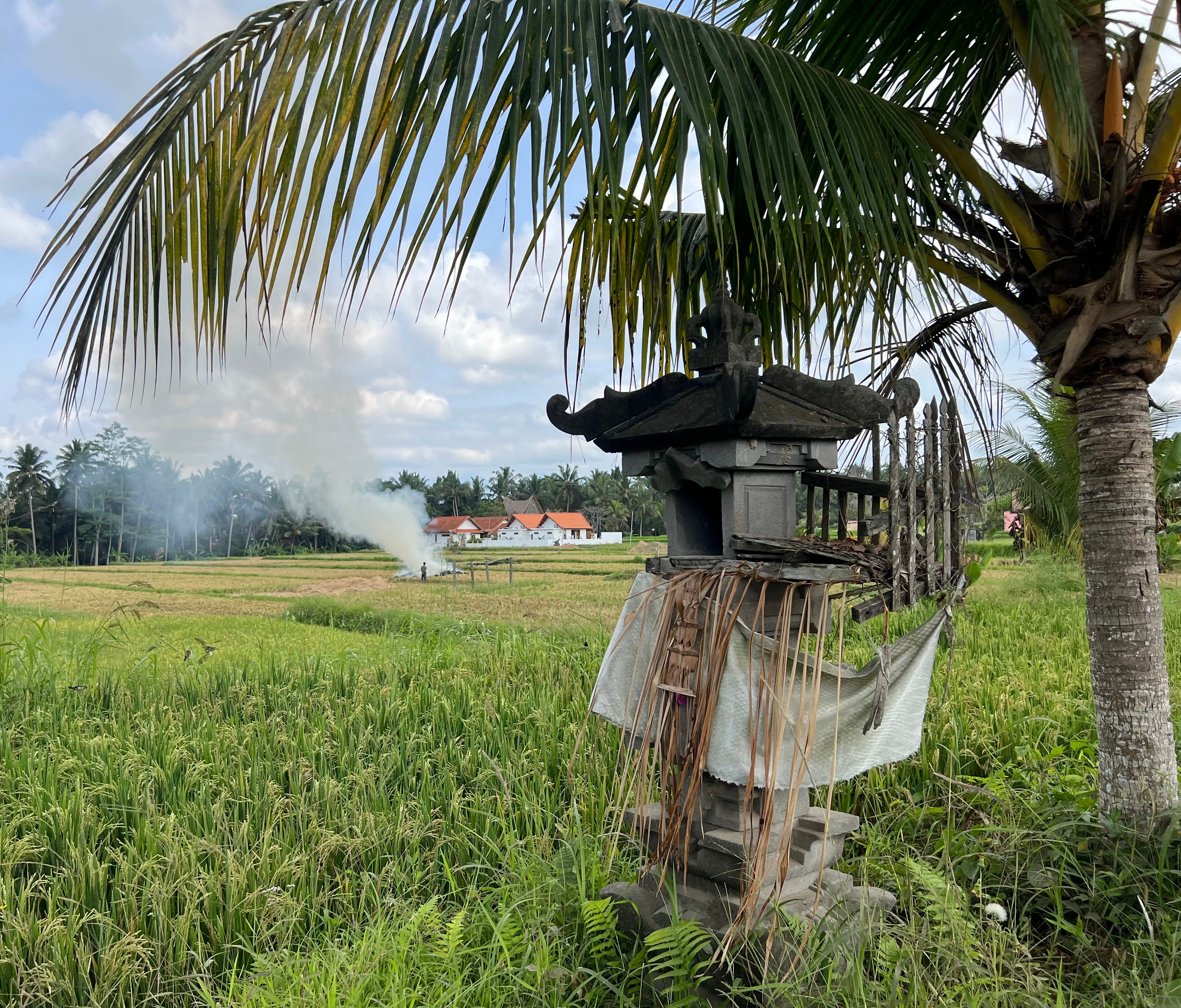
A few weeks ago, I was in Ubud, Bali, hiking on a footpath for tourists along rice paddies. I came across an old woman, a local, sitting in the grass. I said one of the few Indonesian words I know: good morning, Pagi. A broad smile revealed her two remaining teeth. She pointed at a basket containing baby bananas. I was not hungry and had plenty of fruit at home, but perhaps this was not about what I needed.
The woman appeared to be part of the landscape, like a tree or a shrine. She belonged there. And she represented an opportunity to interact and exchange.
How much for some bananas? Thirty. Thirty thousand Indonesian Rupiahs, about a dollar and sixty cents. A premium price compared to the corner fruit store, yet affordable for any Western tourist, even a writer. Alright. I pulled out my bundle of colorful Indonesian notes and looked for some purple ten thousand bills. Instead, a red hundred thousand note escaped my fingers and fell to the ground.
The woman laughed and pointed at the money in front of her. Her voice sounded so joyful, so innocently amused. I stared at the money. This did not feel like a coincidence. I guess this one wants to stay here, I said, more to myself than to her.
I continued on my walk, having vastly overpaid for some delicious bananas, yet feeling warm and grateful for the chance to make an offering to the island.
I don’t mention this to highlight my generosity or look ‘holier than thou.’ If anything, I find the wealth disparity in South East Asia quite challenging to navigate (more on that another time). This was merely the moment I realized that offerings don’t have to look like a ceremony or ritual. No deity was invoked. No tobacco or incense was lit. Neither mantras nor hymns were sung, yet the moment felt sacred.
I’ve hesitated to write explicitly about spirituality, about what I do or believe. One reason is that this is still fairly new to me. Five years ago, my gaze was firmly fixed on the material world. Then I bumped into God, or they into me, and lo and behold one life ended and another began. This has been a messy process and as a former agnostic I often feel uncertain and self-conscious when I adopt a new practice.
For the Balinese the daily offering is as natural as making breakfast. 1 Every morning they place little palm-leaf baskets, called Canang Saris, in doorways, on sidewalks, in shrines, sometimes even on top of their scooters. These contain items like flowers, cake, snacks or rice, and a stick of burning incense. For most of my life I would have looked at that as a quaint superstition. Well, now I too light a stick of incense and give thanks.

When I arrived on the island, I was struck by my utter dependence. It takes countless animals, plants, and people to make my life possible. In Bali I saw them not as life forms separate from the land, but rather as its expression, the way a flower rises from its roots. And I felt a desire to honor this hospitality. I was fed and wanted to feed back. I was being nourished every day: how could I not want to walk in a spirit of gratitude and kindness?
Years ago I saw things very differently. I felt lost and alone in an indifferent world and counted on money to save me. I wanted to buy my way out of a deep confusion and soothe my alienation. Money did buy me some independence. I feel very privileged to make my own schedule, to travel, eat healthy food etc. But I no longer seek distance.
Instead, I find my existence defined by being in relationship. I am rooted downward into mother earth. I feel my inner thread connected upward to the source of creation. And all around me I find the community of life. I am always in exchange with a vast and mysterious web.
As lonely as my journey can feel at times, I know I never walk alone. Making an offering is an attempt to strengthen this inner thread of loving connection.
A practical example was food safety. Bali is notorious among tourists for gastrointestinal issues (‘Bali Belly’). Of course, that’s because our immune systems are not equipped for the local environment. . . but could it also have something to do with our relationship to the place?
I am not suggesting that pathogens magically disappear if you treat a place with reverence. But I try not to rely only on my mind. I try to tune into my intuition. I ask for guidance. And I feel much better asking when I am in the spirit (and habit) of giving. (And personally I now thoroughly enjoy a pause before eating to give thanks and ask for the food to be blessed.)


I see offerings as acts of devotion that ground me in gratitude. I acknowledge my dependence and honor that which sustains me. I just don’t think this has to look or sound ‘spiritual.’ We can be inspired by cultures that make offerings to the world of spirit, but the loss of a tradition also presents a chance to examine it with fresh eyes. If offering fruit to spirit does not resonate, why not start with generosity to its living expression?
Why not start with the offerings so simple they are available to anyone: treat others with kindness and compassion. Offer smiles, words of gratitude, encouragement. Pick up a piece of trash instead of lighting another stick of incense.
If you are unsure about how or what to give, maybe just ask? Thank the land for holding you, feeding you, welcoming you. Touch it — the soil, the trees, the rocks. Ask what you could offer. Get quiet. Listen. Pay attention to what and who you encounter later that day.
I am convinced our relationship to the world matters. And perhaps we should not be surprised if some places, if not being offered, simply take. If we meet the world with an attitude of consumption, why would the exchange not be fulfilled in subtle and perhaps unpleasant ways?
May your journey be an easy one.
May you be healthy, happy, and showered in love,
Frederik
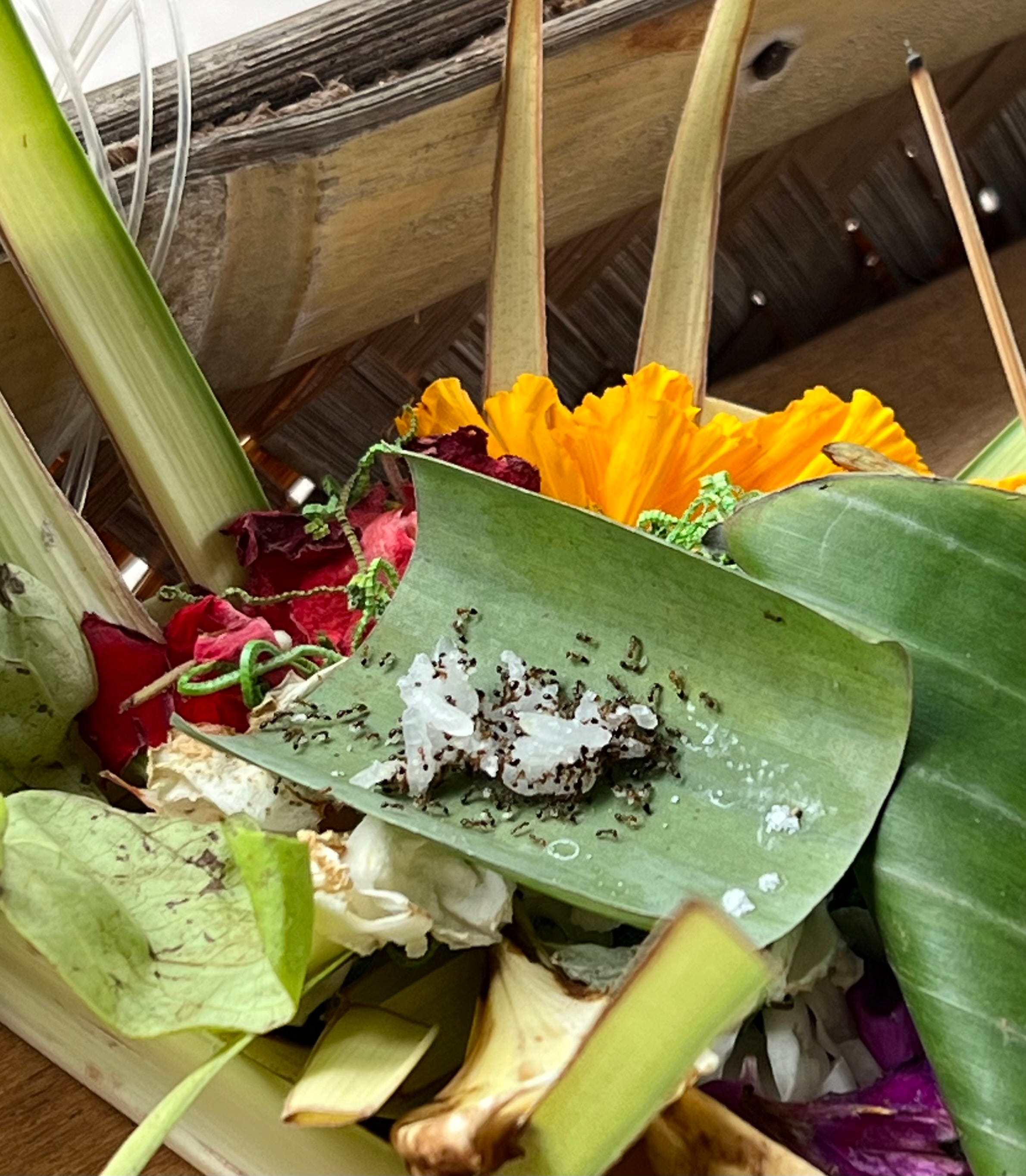
A driver told me his family spends between one and two million Rupiah a month on offerings and temple donations (up to five million during the big Galungan festival). By comparison the regional minimum wage is around three and a half million Rupiah. A restaurant manager explained, “if you need three people, hire six,” because employees are often away for ceremonial duties. I doubt it is a coincidence that the island’s energy feels so potent (and no wonder the island attracts so many visitors from financially rich but spiritually impoverished places).
Frederik, this might be my favorite post of yours I’ve read yet. I felt it allowed me to know a bit more of you and your story and the journey you’re on in the most authentic way. I love you and I appreciate your courage to show the world who you are❤️
Sharing experiences like yours in Bali are so important. Reminding people that visiting a country can offer so much more story and depth than just a rice paddy selfie. I hope more of your thousands of subscribers read this piece.