

Anybody else feel heavy these days?
I do. I mean heavy. Like, end of the world heavy.
I couldn’t even write about it. It was stuck in my body like concrete poured into my limbs. It took an hour of breathwork, sobs and ugly crying, to move what had been frozen.
See, I had been shaming myself for feeling down. I am in sunny middle-of-nowhere, New Mexico, with food, a car, and access to nature. Plus a demonic little box with more entertainment and information than is good for anyone. What more do you want?
But this had nothing to do with my material comforts. I felt a weight of the soul.
In a way the material comforts made it worse. I wouldn’t want to give them up, but they remind me that I am indebted to the system of prosperity that, by and large, is running the planet into the ground. Oops. Wasn’t supposed to say that.
Anyway. That’s what it felt like. Heavy and ominous. Things coming to a head.
When will we sit down for our banquet of consequences? This decade? Later this century? I don’t know and it doesn’t matter. You don’t have to be there for the cataclysm to shiver in its shadow. You don’t have to watch the tree fall. It’s enough to feel its rot, to notice that the structures of support keep weakening. You don’t have to be pummeled by disaster, war, or state-sanctioned kidnapping campaigns to feel their effects. The pain ripples through our collective tissue.
In LSD and the Mind of the Universe Christopher Bache described his series of psychedelics-induced ego deaths. Each took him to higher levels of consciousness. Notably, his individual ego died to experience “humanity as a single organism with intelligent networks running through it.” Individual minds appeared to him “as nodes in the network of the species-mind, each of us fractally mirroring selective themes of this larger consciousness.”
We are all bound together and subtly affected by the collective experience. Is it any surprise then that many of us are feeling heavy right now?
There is no shortage of people writing and talking about crises and confrontations. We’re surrounded by the evidence. It is remixed into emotional pornography and algorithmically fed into our veins. We drown in it.
What we don’t have is answers. Like animals we sense a tsunami coming, only there is no hill for us to run to. All we can do, it seems, is to point our fingers at the dark clouds hovering over the water.
Bache too saw our ailing world. Only in his visions the future “global systems crisis triggered by a global ecological crisis” appeared necessary.

Bache was shown that states of “extreme suffering” would prompt the human species-mind to exhibit “nonlinear capacities,” namely “the capacity for rapidly accelerated change, heightened creativity, and higher self-organization.” In other words, enormous pressure would crystallize a jump in our evolution towards a more unified consciousness.
On that higher level, a new way of being would emerge. Until then, locked into the mental prison of our atomized existence, we merely grasp at straws.
I’m not gonna lie, the book can be a depressing read. When Bache mentions a collective death-rebirth in “the next several decades, perhaps the next hundred years,” he is not speaking metaphorically.
“There was less and less for people to hold on to,” he writes, “fewer givens that they could assume—how they would live, where they would live, what they would do for a living, how society was organized, what could be possessed. The world as they knew it was falling apart. The level of alarm grew in the species field until eventually everyone was forced into the melting pot of mere survival.”
One vision disturbed him so much, he walked around “feeling like someone walking around Hiroshima a week before the bomb was dropped.” Frankly, I suspect that he omitted many upsetting details.
His sessions included periods of intense purification and pain, including a hellscape he called the ‘Ocean of Suffering.’1 I had heard that exact term years ago when a female healer described a psychedelic experience of her own. Waves of collective suffering flowed through her. Neither she nor Bache seemed to regret the experience. It seemed like the price of admission to higher realms of awareness.
I wonder if that is what we are sensing today: that the answers to our unholy mess lie on the other side of a terrifying period of purification.
We stand in the wet sand, among piles of trash, listening to the choking birds, wondering when all the fish disappeared.
We stand and watch the angry sea in silent terror, for we sense that soon we may be called to wade into its waters.
Our soul may know about the glorious future rebirth. But first comes the decline, the dissolution, the mulching.
And there is nothing to do but to honor that season.
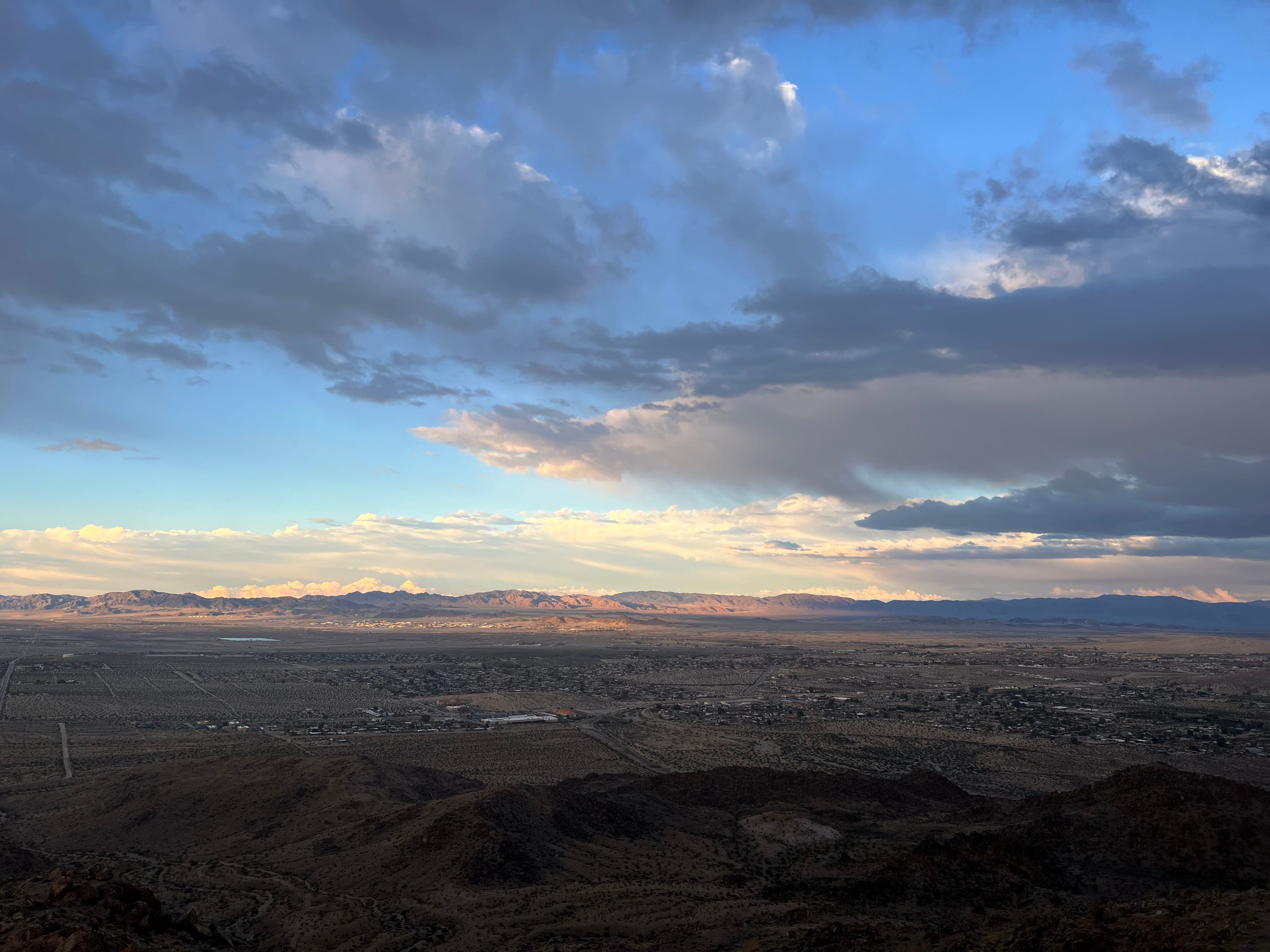
This is my first winter in the desert and the weather has been throwing me off. Warm and sunny during the day. Santa-with-reindeers blow-up decorations stand forlorn among rocks and cacti. Only when the sun sets and the temperature drops does it feel like winter.
But on a more subtle level, winter is real all day. The body yearns to attune to the cycle of the seasons.
There is “no good myth without death,” Joshua Schrei of the excellent The Emerald Podcast reminded me. Death is generative. For something new to grow in the forest, something else must first die.
If winter feels like the end, like being suspended in the void, we know that it is followed by a beginning. Spring will bring a different energy. The sun will melt the heaviness. Eventually, there will be a new world, perhaps even a “New Human” as Bache experienced it. Until then, it’s time to make space for this part of the cycle.
If it feels heavy, that’s because it is.
It’s your heart resonating with what Allie Canton called the Big Heart of humanity.
It’s your lungs participating in our collective heavy sigh.
Trust the value and meaning of your experience. Trust your connection to the whole. If you are called to carry a shard of the collective weight, honor that. Make space for it. Embrace what it teaches. (But do yourself a favor and limit social media time.)
Observe if you are numbing and distracting yourself. What is waiting behind that which we avoid? Maybe sadness, fear, anger, or even blind rage at our inability to fix the world? Whatever it is, now is the time to be with it.
Nature has helped me a lot in this regard. Rest against a tree or a rock. Feel the earth support you. Walk. Gaze at the horizon.
You are not alone in this experience. Your heart has always known this. Time to let that brave heart of yours speak.
See you down the road.
— Frederik
Further notes.
Chris Bache on practicing radical acceptance (just pretend he’s not talking about a psychedelic experience and replace ‘session’ with day or moment):
“If you open completely to whatever arises in your experience, however difficult it may be, and let it take you where it wants to go, the ordeal will build until it eventually reaches some peak expression. When it has spent itself for the day, your experience will then shift into positive transpersonal domains for the remainder of the session.”
Myths connect us to the cosmic cycle of dissolution and becoming. Many origin myths deal with the dismemberment of a deity as part of the birth of the world. Schrei mentioned Ymir, Osiris, and Shakti as examples. Schrei offers an embodied way of reconnecting with myth in his wonderful Mythic Body course.
“In session after session, I was brought back to the same landscape and systematically taken deeper into its mayhem. I came to call this domain the Ocean of Suffering, for it was a vast ocean of fury and pain, enormous in scope and intensity.
. . . I eventually reached a level I can only liken to hell itself. Excruciating pain. Unspeakable horror beyond any imaginings. I was lost in a rampaging savagery that was without bounds. It was science fiction gone rabid. The world of the damned. The worst pictures of the world’s religions showing the tortures of hell only touch the surface. And yet, the torment cleanses one’s being. It tears every piece of flesh off your body until you’ve died a thousand times and can’t die any more. Then you find ways to die some more.”